Friday, 11 April 2014

Q1) In what ways does your media product use, develop or challenge forms and conventions of real media products?


My final products all link together well, you can tell this by looking at all three of them and noticing that they all have the same colour scheme throughout, which is a typical colour scheme for the Indie genre (the dominant colour is red). The main cover artist also appears on all three of my products, which is another way they all link together. The logo and font on the front cover and the other pages is predominantly in the font Impact, I chose this font because it stands out and makes the product look realistic. There is also a secondary font used, which is Myraid Pro, I used this because most magazines use more than one font so they don't look as boring. On each of the pages there is the IMW logo, which is the first thing that you notice on  the pages, making my audience know that it is all part of the same magazine.


Q2) How does your media product represent particular social groups?

Before I began my product I started out by doing some research into who reads similar magazines, such as the NME. By doing so I had found out what social groups I needed to represent in my final product, and I was able to know how both men and women are represented in this genre of music. After doing research into this I discovered that the majority of artist featured in a magazine such as the NME are independent, and with that style the artists like to make things in their videos on the cheap side and simple.


This is the NME's reader profile. The key things to pick up on are:
  • 69% of readers are male
  • 31% of readers are female
  • 52% work full time
  • 29% are still studying
  • 7% are working part time
  • 65% of readers are in ABC1
  • Average age is 24


from these facts I can learn the types of people who are interested in this sort of magazine, so I could in turn aim my magazine towards the same group of people, however I wanted to aim my magazine at a slightly lower age group, and taking into consideration the fact that they will likely be students reading my magazine I have lowered the demographics to the D/E section which is for students and the unemployed . The reader profile of the NME shows the social class to be upper class as the brands which are shown on it can be rather expensive. However the style is sort of vintage so things may not be as expensive as they seem.
To make my magazine fit the same group I had to make the cover look like the sort of thing that similar people would wear.

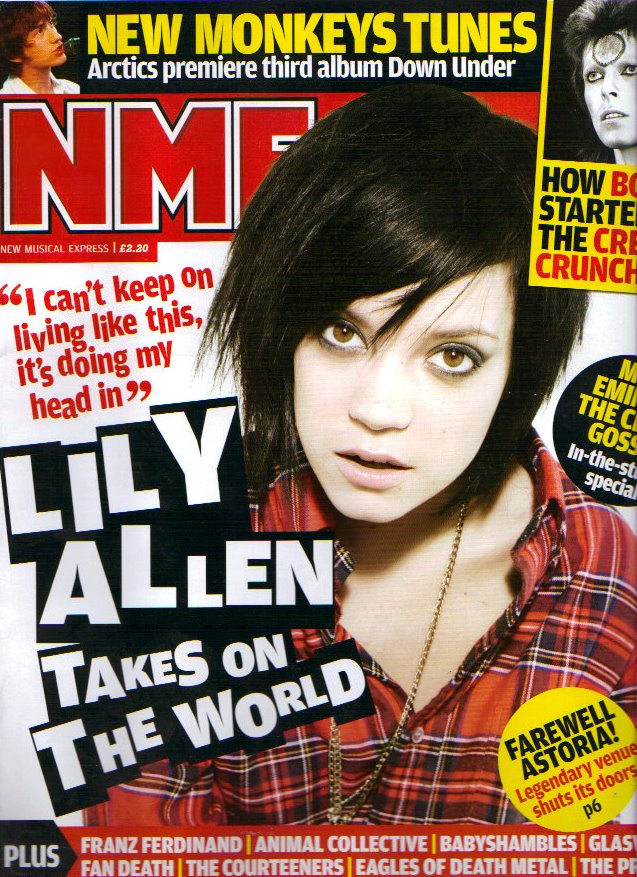
I had to do a bit of stereotyping to get this image for my double page spread, as I had to fit the theme of Indie rock, which is why I decided to go for the vintage denim jacket to attract the audience, as it is the in thing at the moment and the research tells me that it will comply with the majority of the target audience, as you can see with the image of an NME front cover with the artist 'Mia' on the cover with a vintage denim jacket on. Also the fact that the clothing worn is denim the audience expands beyond my target audience as denim is not necessarily that expensive so it opens up the doors to the D/E section of the demographics (which is mainly filled with students)
As you can see from my own reader profile I have aimed my magazine at students which fall into the D/E section.

I have also stereotyped my audience to be students because of some of the prizes on offer, such as the chance to win tickets to Leeds and Reading 2014 which students are the more likely to attend. The artists themselves have been aimed at the students as they are the in thing at the moment, so younger people are going to pay more attention than someone who is older and looking for some old artists.

Wednesday, 9 April 2014

Q4) Who would be the audience for your media product?

My chosen audience for my product was aimed at older teenagers and university students. The reason behind this is they are the same age as most of the artists in the Indie rock genre and they are the ones who are likely to relate to the lyrics used by the artists, another reason is the audience can copy their style as it is individual and from the age of 16 onward people begin to express themselves more. After researching into this genre i found out that both males and females read magazines, however it is predominantly males who read it as they account for more than double the females reading similar magazines.This really helped me in ways, how to style the magazine, and how to style my reader profile.

I had done some research into demographics, and I found out that the average reader of the NME falls into the ABC1 category. So to make my magazine more successful I took the decision to aim my magazine at an audience which the NME does not, and that is the D/E category, which is predominantly students and unemployed people. Taking into account the majority are students I made my model on the front cover to be young so t would attract the audience to it more.


All questions on the questionnaire:
1) What is your name?
2) How old are you?
3) What is your demographic group?
4) What genre does my magazine represent?
5) What audience do you think my magazine is aimed at?
6) What is the most eye catching thing on my cover?
7) Would you alter anything on my magazine?
8) Does the colour scheme and style of the magazine persist throughout all three pages?

Interviewee's 
Paul Deyes
Bryn Stagg


Tuesday, 8 April 2014

Q5) How did you attract/address your audience?

How am I attracting my audience to the magazine?

The following is a list of all of the things which are likely to attract my target audience to my magazine.As through nearly every aspect of the production of my magazine I referred back to my audience pack.


Monday, 7 April 2014

Q6) What have you learnt about technologies from the process of constructing this product?


The Video shows how I made some of the features in my product using photoshop.

The camera which I used was my phone camera as there was none of the supplied camera left.
My phone is a Sony Xperia T which was good to use for photos as it took them in 1280x720 resolution and was in HD

There where two types of computers which I used to create my product, these were the Apple Mac and the Windows PC.

Although I had never used a mac before this project I found it the easier of the two to use and did the majority of the work on it.

Sunday, 6 April 2014

Q7) Looking back at your preliminary task, what do you feel you have learnt in the progression from it to the full product?

Final  Product-Music Magazine    Final Product-College Magazine
PRELIMINARY TASK
My Preliminary task was to create a college magazine front cover, the main reason for this was to help me develop my skills with Photoshop and learn the conventions of a magazine before I started on my final product, being the music magazine. You can see just from the finished products that I have been successful in developing my skills in creating a magazine.

Reviewing My Product


Preliminary Task

In my opinion it was very useful doing the preliminary task as it helped a lot in terms of helping develop my Photoshop techniques and allowing me to get to grips with the conventions of a magazine.I was also able to receive verbal response to my product with things which I should change and how to  go about changing them, and this has had a positive input towards my final product. It was also good for me as I could learn my limits of what I could achieve in a set time frame.

The Skills which I learnt in order to complete my magazine where:
  • Create a background for my model.
  • Change the eye colour of my model.
  • Add tattoos to my model.
  • Clear up the face of my model, with precision.
  • Change the lighting of my photos which appear in the magazine.  
  • Precision cutting out of images.